Florence is compact enough to tempt visitors into an oversized programme. The Duomo, Uffizi, Accademia and river crossings appear close together, but looking properly at major collections takes more time and attention than moving between them. Choose the art you care about first, then give the streets and meals enough space to complete the city around it.
Two full days provides a selective introduction. Three lets you add another collection or a slower Oltrarno outing, while a longer stay can support a Tuscan excursion. Do not spend every available morning leaving Florence before you have enjoyed the reason for using it as a base.
Understand the central layout
The cathedral district provides the most obvious reference point, with the main station at Santa Maria Novella on another side of the compact central area. The Uffizi and Piazza della Signoria lie nearer the Arno, while Ponte Vecchio connects with the southern-bank districts generally described as the Oltrarno.
These areas are walkable in sensible combinations, but a short distance does not account for queues, security and the time spent standing in museums. Choose one morning anchor and a nearby meal rather than repeatedly crossing the centre for unrelated reservations.
The hills above the southern bank add another layer. A viewpoint excursion can be worthwhile, but it is additional exertion rather than an invisible extension of every river walk. Our two-day Florence itinerary keeps these decisions clear.
The Duomo complex: choose the parts that interest you
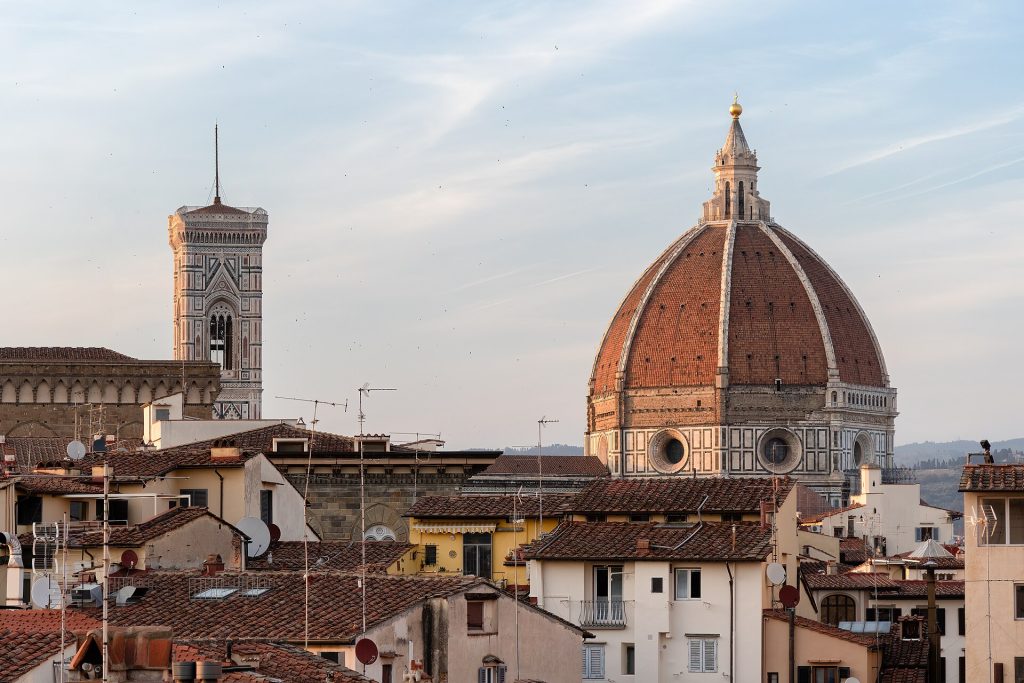
The cathedral’s exterior gives the central streets an immediate architectural focus, but the wider complex contains different spaces and visits. The cathedral interior, dome, bell tower, baptistery and museum should not be assumed to form one uniform, freely interchangeable experience.
Read the current product and booking arrangements for the precise elements you want. Climbs have physical demands and separate timing considerations, so choose them deliberately rather than assuming a first visit is incomplete without reaching every high point.
If architecture and context are the priority, the museum can offer something different from a climb. If you mainly want the exterior setting and a selective interior, leave space for other interests rather than buying the broadest product by default.
Give the surrounding streets time too. The district is busy, but a quieter coffee stop or a smaller lane can provide a useful interval without needing to be advertised as a secret corner.
Uffizi: make a route through the art
The Uffizi is a major collection, not simply a building containing a few pictures to photograph. Choose a limited set of artists, periods or works as starting points, then leave attention for something you did not expect to enjoy.
Use the official Uffizi ticket information to choose the actual product. General gallery admission, combined passes and specialist routes can include different spaces and conditions, so compare scope rather than treating every similarly named offer as equivalent.
A booked entry still requires finding the right entrance and allowing for checks. Do not attach a meal or another museum so tightly that the whole visit becomes a calculation of how quickly to move through rooms.
Plan a substantial seated break afterwards. Even visitors who love art benefit from a different kind of activity before the next collection. Our Uffizi and Accademia guide explains how to separate them sensibly.
Accademia: David with room for context
Michelangelo’s David is the obvious reason many visitors choose the Accademia. Give the sculpture time beyond the first photograph, noticing scale, material and how the work changes as you move around it within the permitted visitor route.
The surrounding collection can add context rather than merely delaying the main encounter. You do not need to read everything equally, but a selective look at other works makes the visit more than a brief check of a famous image.
Book through the museum’s official channels and verify the exact entrance and conditions. If you choose both the Uffizi and Accademia on a short stay, different days often provide a better balance than one long sequence of admissions.
Piazza della Signoria and the Arno
The square around Palazzo Vecchio offers an architectural and sculptural setting that can anchor a worthwhile walk without another large museum. Appreciate the public space, then choose whether a particular interior adds enough to your interests to justify the time.
Continue towards the Arno for a different scale after enclosed streets and galleries. Ponte Vecchio is a natural crossing to see, but it remains a working pedestrian route with shops and other people moving through. Keep circulation clear when stopping.
The river can supply the flexible part of the day. Walk a section, pause for the view and choose a return that suits your energy. You do not need to cover every bridge or both banks completely for the setting to become part of the trip.
Oltrarno: give the southern bank its own time
The streets around Santo Spirito and the wider Oltrarno provide a different neighbourhood setting, with workshops, food and cultural interests. Visit because you want to spend time there, not simply to collect a supposedly more authentic alternative to the famous centre.
A meal, a smaller church visit or browsing a few shops can make a substantial afternoon after a museum morning. Be considerate around working businesses and private entrances; an artisan association does not mean every workshop welcomes unannounced photography.
Pitti Palace and the Boboli Gardens are major possibilities on this side, but together they can change the scale of the day considerably. Choose the collection, garden or combination that matters to you instead of treating them as a brief addition to a café outing.
Gardens involve walking, gradients and exposure. They are a change of setting, not an automatic rest break suitable for every tired visitor.
A viewpoint without exhausting the day
The outlook from the Piazzale Michelangelo area provides a familiar perspective over Florence. Decide how you want to reach it and return rather than simply following a steep walking line after an already demanding morning.
The climb can be enjoyable for some groups; others may prefer transport uphill and a shorter route from there. Check conditions and your energy, especially in warm weather or when travelling with young children.
Sunset is not the only useful time. A daytime outlook that fits the itinerary may be more comfortable than organising dinner around a popular prescribed hour. Choose the experience you want rather than expecting the same light as a promotional photograph.
Food and market choices
Florence gives you opportunities for Tuscan cooking beyond a queue for a famous sandwich. Ribollita, pappa al pomodoro, meat dishes and simpler bakery or café stops can provide different meals across the stay. Ask what is available and how it is prepared rather than expecting every venue to reproduce one regional menu.
If ordering a large steak or another dish priced by weight, clarify the likely portion and total before committing. Sharing works well when the serving format is understood rather than assumed.
Market areas provide another kind of outing, but distinguish produce trading from food-hall dining and individual restaurant hours. Choose according to what interests you and keep the visit near the day’s route.
Reserve a meal that matters and let others remain flexible. A proper lunch can be the pause that makes the afternoon enjoyable, particularly after concentrated gallery time.
Where to stay
The Duomo area suits travellers who want the classic central setting close at hand. Oltrarno appeals when its evenings and southern-bank interests are part of the plan. Santa Maria Novella is worth comparing for rail arrival and practical connections, with the precise street still important.
Our Florence accommodation comparison examines the trade-offs. Check room orientation, entrance steps and the real bed arrangement rather than choosing only from a terrace photograph.
If arriving with a car, ask about parking and restricted access before navigating into the centre. A city visit often works better with the vehicle left in arranged parking rather than moved between nearby sights.
Day trips: add time, not pressure
Siena, Pisa and Lucca offer different outings. Choose Siena for its particular historic-city interests, Pisa for more than a single tower photograph or Lucca for a different town rhythm and walls setting. They should not automatically be combined into one hurried day.
Our Tuscan day-trip comparison explains the practical distinctions. If you only have two days, consider whether another Florence collection or a slower neighbourhood afternoon would be more satisfying than an excursion.
For a longer stay, a planned day outside the city can provide useful variety. Check the actual transport and return, and avoid putting an unfamiliar excursion immediately before a fixed flight or distant rail connection.
Keep art and ordinary time in balance
Florence is most rewarding when major reservations have space around them. Secure the experiences you want, then leave enough room to notice a façade, sit by the river or enjoy a meal without counting the minutes to the next entrance.
Choose the season and daily rhythm accordingly: outdoor sections earlier in hot weather, a useful indoor alternative when conditions are poor and fewer major collections when attention is fading. The compact centre makes a good visit easier to organise, but it does not make time inside its art collections disappear.
A smaller church or cultural visit
Florence’s art is not confined to its two most famous galleries. Santa Croce, San Marco and other cultural sites can offer a different focus for visitors whose interests extend beyond a broad survey of Renaissance painting.
Choose one according to the works or history you want to understand, then check current access. A religious building, museum and specialist visit may operate through different arrangements even when they occupy related spaces.
The strongest addition replaces part of another programme. If you want to give a smaller collection proper attention, shorten the shopping or viewpoint section instead of simply increasing the day’s hours on your feet.
Florence on an arrival afternoon
A short neighbourhood walk and a meal can be enough after an intercity journey. Store luggage, identify the route to the next morning’s reservation and leave the first evening open.
That smaller plan is especially useful when travel has been tiring or the weather is uncomfortable. You can enjoy the river or a central square without making a major collection depend on a perfectly timed arrival. It also gives you a better sense of the distances before the most structured art day begins.