Seville is easiest to enjoy when you plan around its two great indoor visits, then let the streets between them fill the rest of the day. The Real Alcázar and cathedral deserve attention, but so do a quiet square in Santa Cruz, lunch away from the busiest monument approaches and an evening across the river in Triana. Give the city at least two full days; three makes the pace considerably more comfortable.
The historic centre is compact enough for substantial walking, although heat can change what feels manageable. Choose accommodation that makes a rest practical, book the sights you care about and avoid treating every palace, church and terrace as an obligation.
Get your bearings
The cathedral, Giralda and Alcázar form the main sightseeing cluster, with Santa Cruz’s narrow streets immediately alongside. North of them, the central shopping streets and squares lead towards areas around Plaza del Salvador and beyond. The Guadalquivir runs along the western side of the historic core; crossing the Isabel II bridge takes you into Triana.
South of the cathedral district, the route towards Plaza de España and María Luisa Park makes a natural separate outing. These places may look close together on a map, but combining every cluster with several indoor visits creates a long day. Think in mornings and evenings rather than a single continuous circuit.
For a ready-made sequence, our two-day Seville itinerary keeps the main stops together while allowing proper breaks.
Start with the Real Alcázar
The Alcázar brings together palaces, courtyards and gardens shaped by successive periods of royal life. Its Mudéjar decoration is a particular reason to visit: patterned surfaces, arches and controlled views between rooms give the architecture a richness that rewards looking slowly. Resist the temptation to make the best-known courtyard your only destination.
Reserve through the official Alcázar visitor page, which links to its current ticketing service. Check the ticket’s exact scope before paying, especially if considering additional rooms or a guided experience. Bring the identification required by your booking and allow time for entry procedures.
The gardens belong within the visit, but they are outdoor space rather than a guaranteed escape from summer heat. Split your attention between rooms and gardens according to conditions, and leave a generous gap before another reservation. With children, choosing a few details to notice can work better than expecting sustained attention to every decorative surface.
Cathedral and Giralda: give the visit a focus
Seville Cathedral occupies a central place in the city’s skyline and history. The large interior rewards a selective approach: look at the scale of the nave, choose a few chapels or works that interest you and take time to understand the setting rather than trying to inspect everything equally.
The Giralda, incorporating the former mosque’s minaret, adds a different perspective. Decide whether the climb suits your group before making it part of the plan. An attraction described as using ramps can still involve considerable exertion, and the cathedral visit remains worthwhile without reaching the top.
Consult the cathedral’s official website for visitor access, ticket combinations and any changes associated with religious services. Treat it as a working religious building as well as a monument: dress appropriately and follow local instructions about photography and behaviour. Do not assume sightseeing access operates on the same basis throughout the day.
Santa Cruz: explore between the landmarks
Santa Cruz is an obvious place for a first walk, with small squares, narrow lanes and the cathedral district close at hand. It is also a heavily visited area. Expect a shared sightseeing setting rather than a secluded neighbourhood waiting to be discovered.
Follow a loose route through a few streets and pause where the space opens out. You do not need to turn every attractive doorway into a historical claim. A guided walk can be useful if you want context, but choose one with a clear subject and duration rather than adding it automatically after two long monument visits.
For food, look beyond the nearest menu board at a major entrance. Compare what is actually offered and how you want to eat: a seated lunch can be more restorative than moving between crowded counters. If staying here, check whether your room faces a restaurant terrace or a busy pedestrian route.
Plaza de España and María Luisa Park
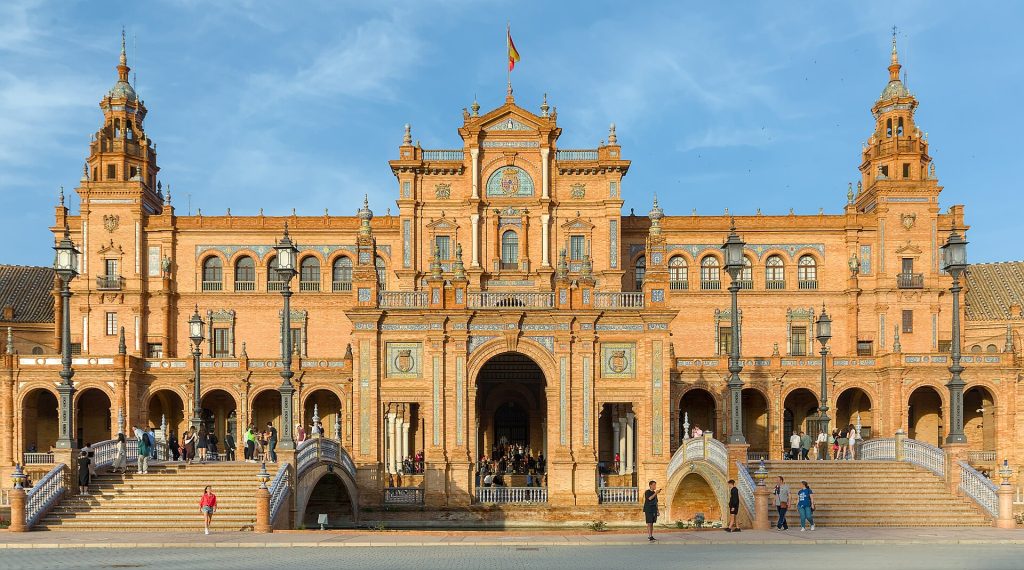
Plaza de España’s broad sweep, bridges and tiled details make it a different experience from the tightly enclosed streets of Santa Cruz. Built for the Ibero-American Exposition of 1929, it is worth visiting for the ensemble rather than rushing to photograph one decorative panel.
Pair it with a walk in María Luisa Park. Trees and gardens provide places to pause, but the outing still involves outdoor exposure. Start early in warm weather and keep enough water for the walk. Hiring a boat or adding another activity is optional; the architecture and park make a worthwhile visit on their own.
Families can use this outing as a change of pace after the cathedral or Alcázar. Avoid making the park the reward at the end of an already exhausting day. Enjoying it properly may mean returning to the centre for lunch and leaving another attraction for tomorrow.
Cross to Triana
Triana sits across the river and gives a useful counterpoint to the monument-heavy centre. Its associations with ceramics, food and flamenco form part of its identity, but it is also a lived-in district with ordinary shops and residential streets.
Cross the Isabel II bridge, look around the market area and continue into nearby streets before deciding where to stop. River views are part of the appeal, though a waterfront table is not automatically the best meal. Compare menus and seating, especially if you need a break rather than another standing snack.
Triana works well for an evening when you are happy to walk back across the river afterwards. If you book a performance or late dinner, consider the return to your accommodation before ordering another round. Distances that felt easy at the start of the day can feel different after several hours on your feet.
Food, markets and flamenco
Tapas are a practical way to explore several dishes without committing to a large plate, but portion sizes vary. Start with a small order, then add more. A larger ración is often intended for sharing, so clarify the size rather than ordering from the name alone.
Look for regional dishes such as espinacas con garbanzos, spinach with chickpeas, or carrillada, slow-cooked cheek, alongside simpler options. Cold soups can be appealing in warm weather, though their ingredients and garnishes vary. Our Seville food guide explains how to approach meals and markets without turning dinner into a checklist.
For flamenco, choose a performance because you want to watch and listen attentively. Compare the setting, running time and whether food or drinks are included. A smaller venue and a dinner show offer different evenings; neither should be judged solely by the most dramatic promotional photograph. Arrive with time to settle in and follow the venue’s rules on filming.
How many days to allow
Two full days can cover the Alcázar, cathedral, Santa Cruz, Plaza de España and a taste of Triana, provided you keep the rest selective. Three allows a slower morning, another cultural visit or more time for meals and neighbourhoods.
For a one-night stay, prioritise rather than compress. Choose your essential paid visit, then build an outdoor route around it. Arriving at midday and departing the following afternoon does not reliably provide two sightseeing days once luggage and transport are included.
An extra night can also make practical sense in summer: dividing activities across several cooler mornings may be more enjoyable than trying to complete the city in two demanding days.
Where to stay
Santa Cruz is convenient for the cathedral and Alcázar, especially if walking out into the historic setting is a priority. Centro offers a broader search around shopping streets, restaurants and connections. Triana suits travellers who value its evening atmosphere and are comfortable crossing the river for the main sights.
Use the precise address rather than a generous neighbourhood label. A quiet room, effective air conditioning and straightforward access with luggage can matter more than saving a few minutes on the morning walk. Our Seville accommodation comparison sets out the trade-offs for different travellers.
Getting around
Walking is the natural starting point within the historic core. Use a bus, tram, taxi or another suitable connection when the walk becomes a logistical burden, particularly with luggage or during hot weather. Check the actual route instead of assuming that the nearest stop serves the direction you want.
If arriving by train, remember that Santa Justa station is outside the cathedral cluster. Look at the final journey to your property and its recommended drop-off point. In the narrowest streets, a taxi may not reach the door, so ask how far you will need to carry bags.
Driving is rarely a useful default for central sightseeing. If you bring a car, confirm parking and access arrangements with the accommodation before arrival rather than navigating towards an old-town address and hoping to find space nearby.
Choose the season and daily rhythm
Spring and autumn are sensible starting points for a trip built around walking, although popular events can transform availability and prices. If your dates coincide with major celebrations, decide whether experiencing them is the purpose of the trip or an added complication to your sightseeing.
Summer calls for a different routine: outdoor walks early, a proper indoor break and a later return when conditions allow. Evening does not guarantee cool temperatures. Our summer travel advice helps you adapt bookings and accommodation to the weather.
Winter can suit cultural sightseeing, with shorter daylight hours shaping park and river outings. Check the forecast for your actual dates, then pack and plan accordingly. The strongest Seville visit has a few well-chosen anchors and enough flexibility to enjoy the city between them.