For most first visits to Lisbon, compare Baixa and Chiado before widening the search. Baixa makes lower-level orientation and central journeys straightforward; Chiado puts cultural interests, cafés and dining nearby with more hillside terrain. Choose Alfama because you want its historic setting, or Príncipe Real because you expect to enjoy that neighbourhood rather than simply return there to sleep.
The city rewards checking the final approach in detail. A room can be central and still involve a steep climb, stairs before the lift or an awkward transfer with bags.
Compare the four areas
| Area | Strongest reason to stay | Main compromise | Useful room question |
|---|---|---|---|
| Baixa | Practical lower-centre base | Busy streets and tourist activity | Does the bedroom face a main route? |
| Alfama | Historic lanes and hillside atmosphere | Steps, luggage and accessibility | How do you reach the actual entrance? |
| Chiado | Cafés, culture and central flexibility | Gradients and nearby evening activity | Which street and direction does the room face? |
| Príncipe Real | Neighbourhood dining and a distinct setting | More uphill travel for some outings | Does the daily route suit the group? |
These descriptions are search priorities, not live price rankings. Compare the complete stay for your dates, including mandatory charges, breakfast where needed and cancellation conditions.
Baixa: the practical first shortlist
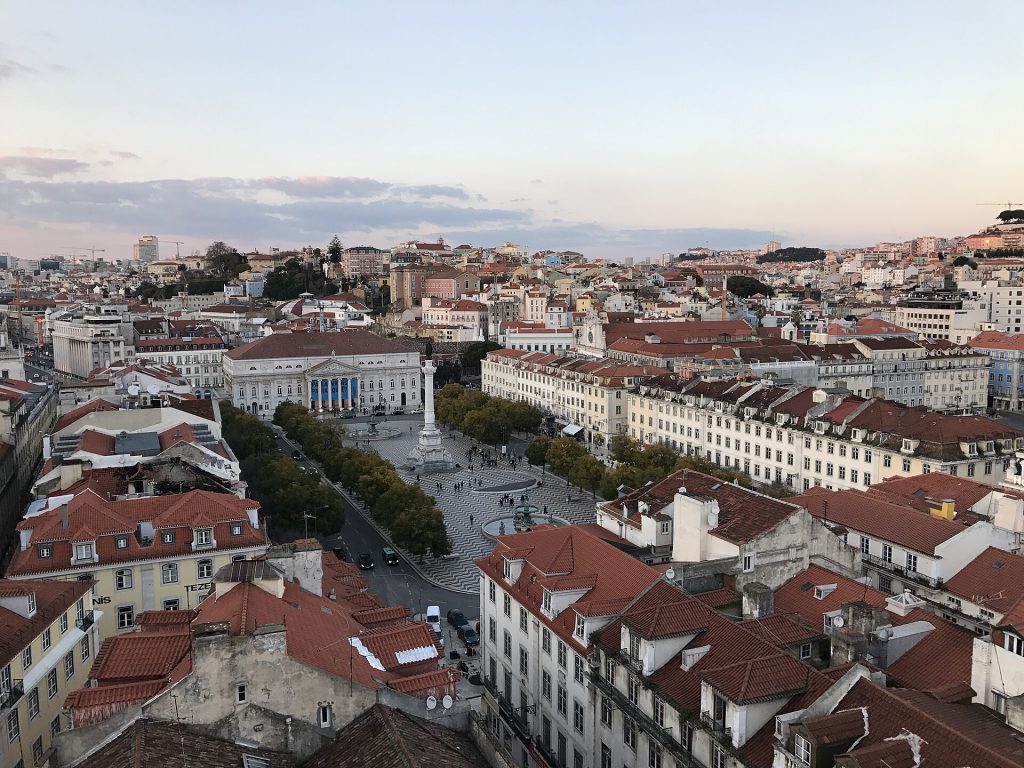
Baixa’s lower grid is useful when you want an easy reference point for the city. The river and Praça do Comércio help orient the day, while transport and central streets give you several directions to explore.
This setting can suit a short first visit, a group with mixed interests or travellers who expect to return to their room between outings. You still need to plan hill journeys, but you are less likely to add an uphill approach to every ordinary return.
The advantages
You can organise a lower-centre morning, travel towards Belém or start an eastern-neighbourhood walk without making the accommodation itself a major excursion. Meals and shops are available nearby, although the most obvious streets can be busy and visitor-focused.
For an airport arrival with luggage, proximity to a convenient station or pickup point can help. Test the actual route rather than assuming the district name guarantees a short level walk from every connection.
The compromises
Busy pedestrian streets are not automatically quiet. Restaurants, deliveries and evening activity can affect bedrooms even where traffic is limited. Ask about window insulation and the room’s orientation.
Older buildings may have entrance steps or lifts that do not solve the full journey to the room. A modern-looking interior photograph does not establish that the entire approach is step-free. Request concrete details if this matters to your group.
Baixa is strongest when practicality is the main goal. If you want a more residential-feeling evening setting, compare the other areas while keeping the daily travel trade-off clear.
Alfama: stay for the atmosphere, accept the terrain
Alfama’s lanes, stairways and changing outlooks can make returning to the neighbourhood a memorable part of the trip. It appeals particularly to visitors who value the setting itself and are comfortable spending time on foot among the slopes.
It is not the easiest universal recommendation. A nearby station or taxi route may still leave a demanding final approach, and bags can change how a short distance feels. Families with a buggy and anyone with mobility needs should inspect the whole route before booking.
Questions to ask before paying
Request the exact vehicle drop-off point, number of entrance steps and whether stairs continue inside. Clarify how a late arrival works, including access codes, contact details and what happens if the person meeting you is delayed.
If a balcony or roof view is central to the decision, confirm that it belongs to your accommodation category. A shared terrace reached by a staircase is a different feature from a private balcony outside the bedroom.
Sleep and neighbourhood life
Alfama is residential as well as a visitor destination. Some streets can be quiet at one time and active at another, and nearby dining or performances can affect the evening atmosphere. Read recent, specific comments rather than assuming narrow lanes guarantee silence.
Be considerate in return: late conversations, rolling luggage and repeated arrivals can carry in close streets and older buildings. Choose the district for what it offers without expecting the neighbourhood to operate like a sealed hotel resort.
For a first trip with frequent room returns, compare a lower Alfama address with one much higher on the slope. The difference may matter more than a small change in nightly rate.
Chiado: flexible, but inspect the boundaries
Chiado works well when you want cafés, shops, cultural interests and a central position that supports several kinds of day. It is a strong alternative to Baixa for visitors happy to manage more changes in level.
The location can suit couples, short cultural breaks and travellers who expect to spend some evenings nearby. Its value comes from using that setting, not simply paying for a recognised district name while spending every day elsewhere.
Where the label can mislead
Look at the actual street and its relationship with Bairro Alto and other neighbouring areas. A listing that emphasises centrality may place the bedroom close to late-night activity rather than the café setting shown in the promotional images.
Confirm the simplest route from your likely transport stop, particularly with luggage. Lifts and escalators can help on some routes, but relying on a single facility without an alternative can make arrival awkward if it is unavailable.
How to compare the room
Check daylight, usable floor space and the bed arrangement as carefully as a roof terrace. A room can be stylish yet leave little space for two cases or a child’s sleeping setup.
For warm dates, ask about effective cooling in the bedroom. For a longer stay, determine whether the room gives you a comfortable place to sit when you are not ready to go out again. A good central base should support rest as well as movement.
Our three-day Lisbon itinerary gives you concrete journeys against which to test a Chiado address.
Príncipe Real: for a neighbourhood you will enjoy locally
Príncipe Real is worth considering when its shops, garden setting and dining appeal form part of your plan. It can suit a slower visit in which not every evening follows a long return from another part of the city.
The location requires a clear view of terrain. Some journeys towards the lower centre are downhill on the way out and uphill on return, which is pleasant for one outing and less attractive when repeated several times with children or bags.
Who benefits most?
Visitors who enjoy local evenings, have several days and are comfortable using transport for some journeys may gain more from this base than someone on a tightly packed first visit. A repeat visitor may also value the setting over immediate proximity to the best-known lower-centre sights.
Do not assume every property is secluded or quiet. Check nearby bars, traffic and room orientation. A neighbourhood associated with a relaxed daytime atmosphere can still contain busy evening streets.
Compare the total routine
Plot breakfast, a main sightseeing departure and the return after dinner. If those feel practical, the location may be a strong choice even when it is not the nearest point to every attraction.
If the room looks cheaper than an equivalent central option, include the transport you expect to use and the value of the time spent travelling. A lower rate can still be good value, but it should be compared honestly.
Other locations can solve specific needs
You do not have to stay within these four districts. An address near a useful metro connection elsewhere can offer more space or a simpler building layout, particularly if a conventional hotel and straightforward luggage access matter most.
Judge those alternatives by actual journey times and final walking distance rather than a claim that the city centre is only a few stops away. Transfers, station circulation and late returns all form part of the experience.
Likewise, a property close to a railway departure point may be useful for one early excursion without being the best base for the entire stay. Choose according to repeated needs rather than solving a single unusual morning at the expense of every evening.
Make the final room comparison
Read the full price and cancellation deadline, check bed types and confirm luggage storage. Apartments require additional questions about keys, kitchen facilities, cleaning and any separate fees. Hotels should still be checked for reception hours and the exact category being purchased.
For accessibility, ask about the entire approach, lift dimensions where relevant and the bathroom layout. A broad accessibility label cannot describe every historic building or hillside route.
Use our Lisbon airport guide to test arrival at the actual door. Then compare your likely city days through the destination guide. A suitable base should make the routine parts of the trip comfortable, leaving the city’s hills as something you choose to explore rather than an obstacle attached to every return.
Families and a realistic midday return
With children, the ability to return for a rest can change the value of a base. Baixa may offer a simpler lower-level routine, while an appealing Alfama apartment can introduce a climb every time you need a nap or change of clothes. Compare that repeated journey rather than only the first day’s sightseeing.
A separate bedroom, space to prepare a simple meal or a useful nearby bakery may matter more than a shared roof terrace. Ask what the actual unit provides, including whether its sleeping arrangement leaves adults somewhere comfortable after a child’s bedtime.
For anyone travelling with limited stamina, the same logic applies. A room near a convenient connection can be worthwhile even if the street is less celebrated. Check the final approach, entrance and bathroom together, so the accommodation supports the entire visit rather than solving one part of it.