For most first visits, start your Barcelona accommodation search in central Eixample. It offers a useful balance of connections, restaurants and access to different parts of the city. Choose the Gothic Quarter if being inside the old town matters more than space and straightforward vehicle access. Choose Gràcia if you would rather build your evenings around neighbourhood squares and accept extra journeys to the waterfront.
There is no district that solves every requirement. A quiet bedroom in a busy area can work better than a poorly insulated room in a supposedly relaxed neighbourhood. Use the area to narrow your search, then judge the exact address and room.
Compare the main areas
Budget tendencies below are relative guides for searching, not live room rates. Accommodation prices depend heavily on dates, room type and cancellation conditions.
| Area | Strongest reason to stay | Main compromise | Budget approach |
|---|---|---|---|
| Central Eixample | Flexible base for a first visit | Traffic on major roads | Broad choice; premium around landmark avenues |
| Gothic Quarter | Old-town atmosphere and walking | Narrow lanes, noise and older buildings | Compare room quality carefully |
| Gràcia | Squares, cafés and neighbourhood evenings | Further from the sea and old town | Compare space against extra travel |
| El Born | Dining and access to the eastern old town | Late activity on some streets | Centrality can command a premium |
| Barceloneta / waterfront | Easy beach access | Less convenient for inland sights | Sea views and terraces can cost more |
| Sants | Rail connections and practical arrivals | Fewer classic sights outside the door | Search for value beyond the station frontage |
Eixample: the most adaptable first-trip base
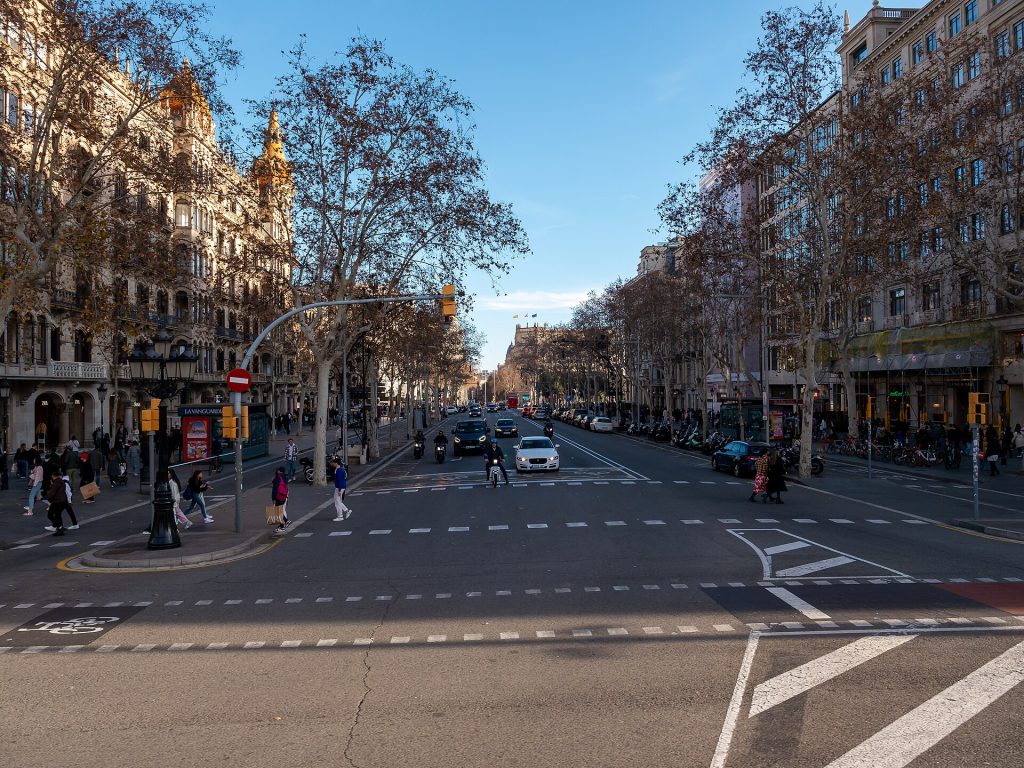
Eixample is a large district, not a single compact neighbourhood. Its grid spreads across much of central Barcelona, so always locate a property on the map before accepting the label “central”. A room near Passeig de Gràcia serves a different daily routine from one near the Sagrada Família or well to the west.
Why it works
This is a good choice if your plans mix Gaudí buildings, old-town walks and trips further afield. The broad streets make orientation relatively straightforward, and there are plenty of restaurants and shops between the major sights. You can enjoy an architectural walk without making every outing a ticketed visit.
For a short trip, compare addresses near the central part of Passeig de Gràcia or Rambla de Catalunya and the surrounding blocks. These give you a useful starting point for several directions. If prices are high, widen the search while keeping a convenient Metro connection.
What to check
Large roads bring traffic, and Eixample also has bars and nightlife. Ask whether your room faces the street, an inner courtyard or building equipment. An interior room may reduce traffic exposure but can also mean less light; “quiet” and “bright” are separate questions.
Mainstream hotels, smaller properties and apartments all require individual comparison. Paying extra for a landmark avenue makes little sense if you intend to spend almost every waking hour elsewhere. A comfortable room on a less celebrated block may suit the same itinerary.
Best for: first-time visitors, mixed sightseeing interests and travellers who want flexibility without staying in the tightest old-town streets.
Gothic Quarter: choose it for the old town
The Gothic Quarter puts cathedral streets, small squares and the historic centre close at hand. It is particularly appealing if you want an early walk before breakfast or to return on foot after dinner in the old town.
Its appeal is the urban setting rather than proximity to every major attraction. Park Güell and the Sagrada Família still require planning, and a central address does not remove the need for transport.
The advantages
You can explore the lanes around the cathedral, Plaça del Rei and Plaça de Sant Jaume without committing to a long excursion. The waterfront and neighbouring El Born are natural additions to a day nearby. This suits visitors who enjoy wandering and stopping when something catches their interest.
The drawbacks
Narrow streets, outdoor activity and older buildings can complicate sleep, luggage handling and accessibility. Check whether the property entrance has steps, whether the lift reaches your floor and where a taxi can actually stop. Do not assume that “renovated” means a building has step-free access.
Be particularly careful with rooms advertised mainly through photographs of a roof terrace or courtyard. Confirm the size, window, bathroom arrangement and bed type of the room you are buying. For a late arrival, establish how you will enter the building and reach someone if the code fails.
Best for: visitors who prioritise old-town atmosphere and compact walks, and are willing to inspect room and access details closely.
Gràcia: for evenings around the squares
Gràcia’s smaller streets and squares create a different rhythm from the avenues below. It works well for travellers who want to spend part of the trip in cafés, independent shops and neighbourhood restaurants rather than returning every evening to a major sightseeing corridor.
The squares around Plaça de la Virreina and Plaça del Sol are useful map references. They are places to linger, but also gathering spots: an address overlooking a lively square is not automatically a restful choice.
The location trade-off
Lower parts of Gràcia make a different base from streets much further uphill. Check the actual route to a Metro station and the gradient with luggage. A property described as “near Park Güell” may be convenient for that one visit while adding effort to everything else.
Park Güell is a natural outing from the area, though proximity does not eliminate the climb. For a wider sightseeing plan, expect to use transport to the old town and seafront. Our four-day Barcelona itinerary shows how Gràcia fits without repeated cross-city journeys.
Who benefits most
Gràcia makes sense for a longer stay, a repeat visit or anyone who values its evening setting enough to accept the journeys. Families may appreciate the squares and local food options, but should still check night-time activity, buggy access and bedroom layout. A square outside the door is useful for a break, not a promise of quiet.
Best for: travellers who prefer neighbourhood evenings and are comfortable using public transport for the main sightseeing circuit.
El Born: dining and the eastern old town
El Born is worth comparing with the Gothic Quarter if you want old-town streets with easy access to the area around Santa Maria del Mar and the route towards Ciutadella Park. It can suit couples and visitors who want dinner and drinks close to their accommodation.
As elsewhere in Ciutat Vella, street-level atmosphere can become bedroom noise. Inspect nearby bars, check room orientation and ask about luggage access. A fashionable location is worth paying for only if it matches how you will spend your time.
For a first visit, it is a credible alternative to the Gothic Quarter rather than a completely different logistical choice: both reward walking locally, and both still require transport for inland attractions.
Barceloneta and the waterfront: stay for the beach
Choose the coast if morning swims, promenade walks or time on the sand are central to the trip. Barceloneta puts you beside the old port and beach area; accommodation further along the waterfront can offer a different setting but longer trips to the historic centre.
Distinguish “sea view”, “near the beach” and “beachfront”. They describe different things, and a road or several blocks may separate your room from the water. Check whether the view belongs to your room category or only to a shared terrace.
Beach access will not shorten your journey to Park Güell. For a sightseeing-heavy trip, compare the extra transport against how often you will genuinely use the coast. The waterfront is easy to visit without sleeping there.
Sants: for rail journeys and straightforward logistics
Sants deserves consideration if you arrive or leave by train, have an early onward connection or want to compare alternatives outside the most sought-after sightseeing areas. Staying near the station can make luggage days simpler.
The compromise is that the classic old-town and Gaudí circuit will usually involve transport. Compare the walking route from the station entrance to the property, particularly with heavy cases; “station area” can cover a surprisingly broad search radius.
For airport arrivals, the train can be useful from T2, but T1 adds a terminal transfer. Use our Barcelona airport comparison before assuming the station-based option is automatically easiest.
Match the area to your priorities
For two or three nights with varied sightseeing, central Eixample is the strongest starting point. For a trip focused on historic streets and walking to dinner, compare the Gothic Quarter and El Born. For a week with slower evenings, Gràcia becomes more persuasive. For a beach-led break, let the coast take priority instead of paying for centrality you will barely use.
If anyone in your group has limited walking stamina, prioritise the actual entrance, room access and nearby transport. The district name is secondary. A direct connection and a manageable final walk often matter more than being closer in a straight line.
Compare the final price and the actual room
Use the full stay total, including mandatory taxes and fees, when comparing offers. Check what is paid in advance, what is due at the property and the deadline for free cancellation. A slightly higher flexible rate may be worthwhile while travel plans remain uncertain.
Confirm air conditioning for your dates, reception arrangements, luggage storage and the exact sleeping setup. A sofa bed, bunk bed and separate bedroom are not interchangeable for a family. For apartments, clarify check-in procedures and any restrictions that affect your arrival.
Read recent comments for recurring issues rather than treating one enthusiastic or angry review as decisive. Look for repeated mentions of street noise, lift problems, cleaning and room size. Then ask the property about anything essential to your stay.
Finally, plot three journeys: arrival with luggage, your first sightseeing morning and the return after an evening meal. If all three look comfortable, you have probably found a more useful base than a listing that wins only on its view or postcode.