Sintra deserves a plan built around hills, entrance times and the space between monuments. Its palaces and wooded slopes can make a rewarding day or short stay, but they are not a compact collection of buildings beside one railway platform. Choose the visits you care about first, then organise transport and walking around them.
One day gives you a selective introduction, usually with one major hilltop visit and another carefully chosen stop. Two days allows a calmer balance of palaces, town time and landscape. A longer stay can include the coast, provided you treat that as a distinct outing rather than an invisible extension of the palace circuit.
Understand the geography
The railway arrival area, historic centre and hilltop monuments occupy different points. Reaching Sintra station is the beginning of the local journey, not proof that you are already beside the entrance on your ticket.
The hills, wooded roads and limited vehicle access shape the experience. A route that looks short can involve a substantial climb, and driving towards a palace is not always permitted or useful. Check the current arrangements for your chosen site instead of assuming a rental car removes the transport problem.
The historic centre has its own interest, with the National Palace providing a different cultural focus from Pena on the hill. Other estates and monuments sit in separate settings, so compare the full route before choosing several admissions for the same day.
Pena: choose the product and protect the time
Not every ticket is the same
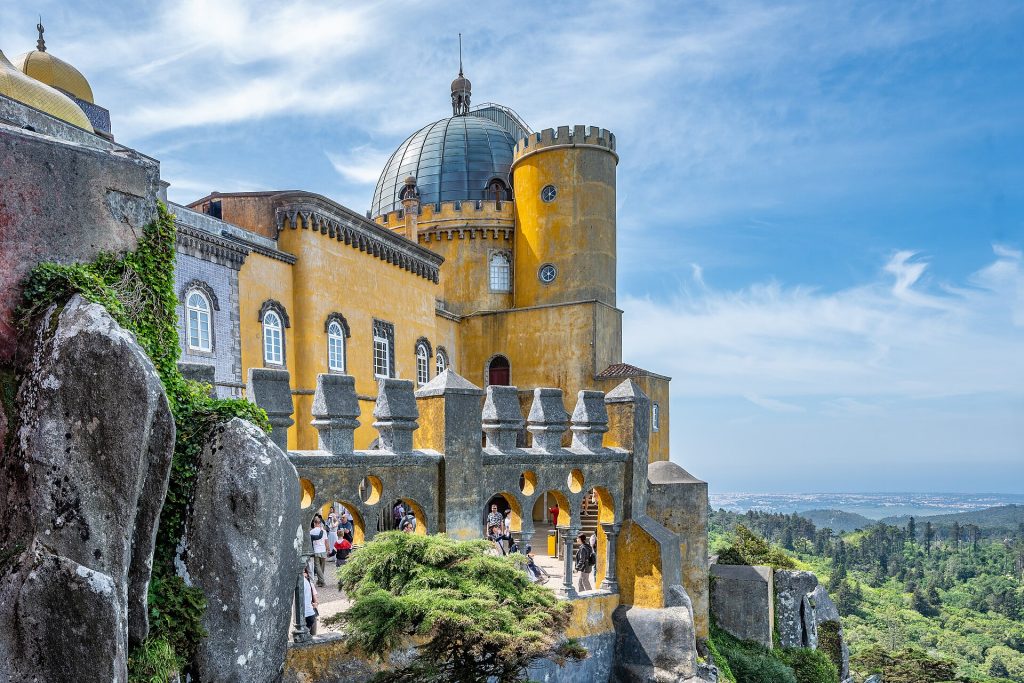
Pena’s palace and park are the obvious starting point for many visitors. Compare the actual spaces included in the available products rather than assuming the word palace guarantees the complete experience you have seen described elsewhere.
Use the official Parques de Sintra website to check the options, access and current conditions. Ticket formats can change, so a saved recommendation about one product may no longer match what is being sold.
The palace time is not the park-gate time
Where your admission has a timed palace entry, work backwards from that point. After reaching the park entrance, there is still an uphill journey to the palace, with the official operator advising a substantial allowance between the two.
Add the journey from Lisbon or your accommodation, local transport, waiting and the approach separately. A train scheduled to reach Sintra shortly before the reservation is not a realistic basis for the visit. Leave room for ordinary delays rather than expecting every stage to connect immediately.
Allow the park to be part of the day
The setting is more than the approach to a photograph. Choose a manageable park route and give the surroundings attention, adjusting to the weather and the group’s walking ability.
If a transport supplement within the grounds is relevant, confirm what it covers and arrange it as required. Do not assume that one ticket automatically removes every climb or walking section throughout the estate.
The Moorish Castle: choose it for the terrain and outlook
The castle offers a different hilltop experience, with walls and outlooks that can complement the palace story. It also adds walking, exposure and changes in level, so decide whether it suits everyone before making it compulsory.
Pena and the castle can appear an obvious pairing, but their proximity does not eliminate the time spent entering, exploring and moving between them. Choose the combination because both interest you, not simply because they sit on the same hill circuit.
In wind, rain or poor visibility, reassess the value of a more exposed visit. A day is not improved by completing every outdoor section when the conditions prevent you enjoying it. Keep the historic centre or another appropriately chosen interior as a different kind of option.
National Palace and historic-centre time
The National Palace in the historic centre provides another route into Sintra’s royal history. Its location can make it a practical second visit, but it remains a substantial cultural stop rather than something to rush through while waiting for the next bus.
Choose the interior according to your interests, then leave time for the surrounding streets and a meal. The centre can be busy, especially when visitors return from the hills, so a seated break may need some flexibility.
Do not use the town solely as a transfer point. Even a short local walk can provide a different scale after large estates and timed entrances. It is also the place to decide whether the group genuinely wants another admission or would prefer the rest of the afternoon without a deadline.
Quinta da Regaleira: a separate estate experience
Quinta da Regaleira attracts visitors for its architecture, landscape and unusual garden features. It is a distinct visit with its own entrance and circulation, not a free continuation of the historic-centre streets.
If the estate matters to you, give it a proper block of time and check current tickets and arrangements through its official visitor service. Popular features can create waiting or one-way movement, so do not base the day on reaching a particular photograph immediately.
Steps, underground elements and uneven terrain deserve thought with children or access needs. Choose the parts that suit your group, and avoid assuming that because an estate includes gardens it is uniformly easy to navigate.
Monserrate and a more selective stay
Monserrate offers another palace-and-garden setting away from the immediate hilltop pairing most first-time visitors consider. It can be a strong option for a longer stay or a selective day focused on landscape and architecture.
The additional location means transport must be planned, not inferred from the general label Sintra. Check the route and return before arranging a visit, particularly if relying on public transport or a driver at a fixed time.
Choose between estates according to interest rather than treating them as a series of interchangeable gardens. One visit experienced slowly can be more rewarding than several entered briefly to justify a broad ticket or tour package.
Forests and walking routes
Sintra’s wooded surroundings contribute to the atmosphere, but a palace-day walk and a substantial trail are different undertakings. Check the terrain, length and current access before following a route away from the visitor circuit.
Weather and ground conditions can differ from Lisbon’s lower centre. Bring shoes with grip and a layer suited to the forecast, and allow extra time on wet paths. Do not treat a blue-sky city morning as a guarantee of identical conditions on the hills.
Follow closures and signed routes, including any restrictions associated with weather or fire risk. If a walk cannot be confirmed easily, choose a shorter known outing rather than improvising through unfamiliar terrain between fixed admissions.
The coast: another day or a deliberate trade-off
The wider Sintra region includes a dramatic coastal setting, with places such as Cabo da Roca and coastal villages offering a different experience from the palaces. They deserve their own transport and weather planning.
An exposed viewpoint is not a place to approach casually in strong wind or to leave marked routes for a photograph. Check the practical access and keep the outing appropriate to the conditions.
Trying to combine Pena, several other monuments and a substantial coast visit in one day usually means reducing each to a brief stop. Our Sintra-versus-Cascais comparison helps decide whether you want hilltop culture or a simpler coastal day in the first place.
Stay overnight or visit from Lisbon?
A day trip is practical when you choose selectively and understand the local journey after the train. Staying overnight can give you earlier or later time in the area and reduce the pressure of returning to Lisbon after a full day.
However, an overnight stay still needs scrutiny of its location. A property described as Sintra may sit away from the station and historic centre, requiring transport for meals as well as monuments. A hillside outlook is a different advantage from straightforward daily access.
Our Sintra and Cascais accommodation guide compares those settings. Choose according to the full stay, including dinner and arrival with bags, rather than one palace reservation.
Getting there and moving locally
Rail from Lisbon is a useful starting point for many visitors, with the appropriate departure and service checked for your date. Our Lisbon-to-Sintra transport guide explains how to think about the full journey.
Once in Sintra, use the permitted local transport and walking arrangements for the sites you choose. Private-car restrictions affect access towards Pena from the historic centre, so do not simply drive towards the nearest map pin and hope to park at the gate.
Organised tours can simplify logistics, but compare the actual admissions, time at each place and meeting arrangements. A long list of included locations may give you less independent time at the one you most want to enjoy.
Build a realistic first visit
For one day, choose a main palace and one additional focus, with lunch and travel treated as genuine parts of the schedule. Our one-day Sintra route shows how to make that selective approach work.
For two days, separate the hilltop outing from another estate or the coast instead of repeating the same rushed circuit twice. Keep weather-dependent sections movable and understand the conditions attached to fixed tickets.
Sintra becomes more rewarding when you choose what to leave out. A properly timed palace visit, an enjoyable walk and a meal without urgency can give you a stronger sense of the place than reaching every famous entrance while continually worrying about the next.
Food as part of a selective visit
Leave time to eat before the next hill journey rather than carrying hunger from one entrance queue to another. A pastry stop can be enjoyable, but it does not necessarily replace a seated meal for a group spending the day walking.
Compare the actual menu and kitchen arrangements near your chosen route. If you stay overnight, ask which dining options are convenient to the property, especially when the room sits outside the historic centre.
That ordinary detail can change the value of a scenic base. A peaceful evening setting is most enjoyable when returning from dinner does not require another transfer you had not planned.